
It was, however, the seventh referendum on the issue of monarchy in 153 years. Questions were raised in the past about the manner in which referendums were conducted and the validity of their results. The decisive majority that cast their ballots in favour of a republic last December left no doubt, this time, as to the wishes of the people.
It is ironical that Constantine, so firmly rejected by the Nation, was the first King of the Hellenes in recent years who spoke Greek well and without trace of an accent. While it could not be said of his ancestors that Greece was their ‘home’, it is probably true of Constantine. The dynasty was not, of course, Greek by blood and from the time that Prince William George, the younger son of the King of Denmark, was declared king in October, 1863 (after the fall of Otto and that house in 1862), its association with Greece was marked by ‘arrivals’ and ‘departures’ and its members remained — in the eyes of most of the populace — foreign. The only Greek connection of the dynasty was Aspasia Manou with whom King Alexander contracted a morganatic marriage. She was the daughter of a dashing equerry in the court of George I.
Supporters of the monarchy have always argued that kings united the country, but it can probably be more accurately said that their existence divided Greeks here and abroad more than any other single issue. (One of the first tasks awaiting the late Patriarch Athinagoras when he became Archbishop of North and South America in the thirties was to unite the Greek Orthodox Churches in the Americas which were then divided along political lines, Royalists and Venizelists having established separate churches so that even small communities barely able to support one church were hopelessly split.)
The Greens and the Browns
VOTING procedures have long presented a problem. During the reign of George I, lead ballots were used in elections but this time they were paper. The voters were given two, one brown and one green. The brown one had the words, Vassilemeni Dimokratia (Crowned Democracy), and the green, Avassilefti Dimokratia (uncrowned Democracy), printed on them. About eight and one half percent of the population is illiterate while an equal percentage are colour blind and cannot distinguish between green and brown, but the statisticians agreed that the probabilities of many voters being both colour blind and illiterate were slight and that they would have little effect on the vote. It was thought by others, however, that the assignment of green to the uncrowned democracy and brown to the crowned, carried a subtle message, green being associated with renewal and hope and brown with less inspiring things. It would certainly have detracted from the dignity of the occasion if citizens had had to walk into a polling station and ask for a kafe—the most commonly used word in Greek for brown — especially since so many polling stations are cafes requisitioned for election day. As it was voters were obliged to accept both ballots but one fashionable lady in a fur coat managed to both announce her political beliefs, and maintain her dignity by entering the polling station and grandly asking for a ‘Marron’ (chestnut) ballot.
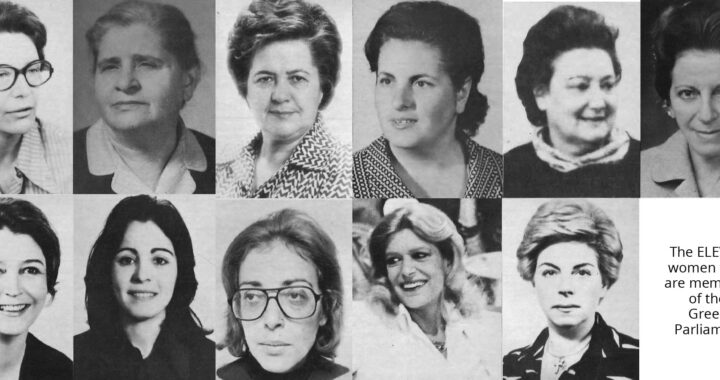
The Rise and Fall of Women
THE 128 students studying obstetrics at Athens’ largest maternity hospital, Marika Iliadou (also known as Elena Venizelou), spent the early part of December on a hunger strike. Inspired by the rallying spirit of mid-November these aspiring midwives spent most of their time on the balconies of the institution shouting for better conditions. The school’s regulations that apply to them have not changed since 1932 and the young ladies now believe them to be too strict. They have petitioned for the following: permission to read newspapers and listen to the radio in their rooms; to be allowed to open their own letters; to be given a day off once a week; to receive a basic wage of one thousand drachmas per month (their food and board are gratis); to be allowed more lessons in broader fields; and, finally, to wash fewer floors and assist at more births.
Meanwhile up at Aghia Paraskevi the young ladies at Pierce College (Deree) staged a sit-in, we are told. Among their demands was one that intrigued us: that teachers speak to them without sarcasm. What we think they really should do, however, is join forces with the girls down at Elena Hospital and devise some sort of strategy to deal with that still all too prevalent husband who goes into a dead faint when he hears that his wife has given birth to a daughter. Perhaps a little Sarcastic Dialogue could be devised. The midwife might appear before the husband, for example, and instead of the usual, ‘Your wife has presented you with a son’, announce, ‘Brace yourself, Mr. Papapoulos, your wife just gave birth to a boy’.
Despite all of this feverish activity on the part of young women, a great number of older women still tend to be sentimental and many responded emotionally to the King’s appeals on television: he reminded many of them of their own sons and, when they didn’t have one, of the son they might have had. One lady of our acquaintance stifled her maternal instincts long enough to cast a green ballot but afterwards shed a small tear for the ex-King wishing that he had at least lost by a lower percentage so that his defeat would have been ‘less humiliating.’
Agni Roussopoulou, writing in Ta Nea shortly before the referendum, addressed herself to members of her own sex on the subject of ‘How Women Vote’, and delivered a mild reprimand to the sentimentalists. Contemplating the fact that 66 percent of Athenian women voted for Karamanlis in the November elections, she came to three conclusions: women are more attracted by the appearance of candidates, more easily influenced by advertising, and more readily victimized by fears than are men.
She reminded her readers that although Mr. Karamanlis is handsome, elegant in dress, and speaks with confidence and ease, it was essential that they recognize his abilities as a statesman as well. This latter qualification, however, could not necessarily be attributed to the monarch just because he, too, was handsome, elegant in dress, and spoke in an effective manner.
‘Why should we cry because a young man wants to return to the tombs of his ancestors? Everyone can do that without having to be a king. Surely there can be no government which would prevent a son from putting a few flowers on the grave of his father, or holding a memorial service in his honour, so long as he was not giving a political connotation to these acts. What a pity if these simple displays of filial affection should become the reason to shackle the entire country with a form of government which has proved a source of ethnic catastrophe!’
She urged women to follow the example of our old hero, Odysseus, and tie themselves up, plug their ears, and not listen to the siren’s song! The recent elections proved that the polling stations are not places to be afraid of but opportunities for self-expression! If women were to use logic and think, then their children and grandchildren would have no reason to regret what they had done!
While we are on the subject of women, we wish to note that although ‘Ladies First’ is appropriate for entering living rooms and leaving sinking ships, in the matter of going to prison it is a singular breach of social etiquette. Despina Papadopoulou’s three-day sojourn in prison last month turned a figure of ridicule into an object of compassion. Accused of receiving 750,000 drachmas from the state without working, the former First Lady was taken from her place of questioning to Korydallos Prison in a Black Maria. She appeared very nervous and upset. Most Athenian newspapers expressed surprise and disapproval. ‘It is unfair to start with a woman’, ‘What is her crime in comparison to those of others committed in the last seven years?’, ‘The meaning of punishment has been diminished’, they cried. Mrs. Papadopoulou was escorted to her cell and then to the dining hall. Ί am not hungry’, she said, Ί only want a glass of water’. (She did not, like the girls at Elena, go on a hunger strike, however.) One thoughtful journalist was reminded of a judge condemned to execution by the guillotine during the French Revolution. When they came for him they found him in bed pretending to be sick. ‘I’m dying,’ he said. ‘Why don’t you execute my wife instead?’
Museum at Delphi
THE Sikelianos Museum is to become a reality at last. It is to be housed in the edifice which the almost legendary poet built fifty years ago overlooking the village of Delphi. It was at Delphi that Sikelianos, together with his first wife, Eva, founded the Delphi Festivals which were the prelude to the summer festivals of today. The building which is only steps away from the brooding cemetary where Sikelianos lies buried, is in a very dilapidated condition. It will be restored and will house the heirlooms which have been kept at Athens College since 1968: his library, furniture and archives. His widow, Anna Sikelianou, will leave other memorabilia on her death. Ί will bequeath everything to the museum which for so many years has been my dream’, she says.
Cost as Varnalis
ONE of the distinguishing marks of modern Greek culture is the reverence felt by the general public for its poets. The funeral of Palamas during the German occupation and that of Seferis during the junta period were national demonstrations. It would be hard to imagine fifty thousand mourners attending the funeral of a T.S. Eliot or W.H. Auden.
Costas Varnalis, who died last month at the age of ninety — some say ninety-two — was the last in a generation of poets, which included Anghelos Sikelianos and Nikos Kazantzakis, who were born in the mid-1880s and flowered at the time of the First World War. Varnalis not only fought the cultural battles of the times but was persecuted by every repressive regime for half a century. Fired as a teacher during the rule of General Pangalos, he was forced to pursue journalism under an assumed name in the Twenties. He was attacked by Kondylis, exiled by Metaxas to the island of Anafi in the Thirties, hounded by fascists in the Forties. His work was banned and his name was unmentionable during the junta of the Sixties and Seventies.
On the evening of December 16th, thousands gathered at the Aliki Theatre to honour the poet who was too ill to attend. Two members of a younger generation of poets paid homage to him: Yannis Ritsos wrote a verse for the occasion, and Nikiforos Vrettakos praised him as a teacher. The popular singer, Bithikotsis, sang some of his favourite poems set to music. Afterwards, Spyros Yannatos, President of the Union of Journalists, accompanied by others, visited the ailing man at his home, and presented him with an honorary diploma and a gold medal in acknowledgment of his contribution to Letters. These were accepted by the clear-headed old poet with a few words. Two hours later Costas Varnalis was dead of a heart attack.
The funeral on December 18th was attended by representatives of the government. While the thousands who gathered sang songs of freedom, his coffin was carried through the streets by young people. He had at least the good fortune to live to see democracy restored and to receive the tribute he well deserved.