The tourist season is over and many of the shops wear their evening dress of gray bars and shutters. Plaka and the city return to the locals and the intrepid travellers who venture to see Greece out of season. Chilly winds stir up clouds of dust and Athena’s ancient stones groan under the weight of the cold and the centuries.
Nearly 250 years ago Pericles called Athens ‘the school of Greece’ and today it is still the city to which scholars of all nationalities come to study the origins of the cultural and political institutions of the western world. So while the city recovers from the tourist season, archaeologists, classicists and historians scurry from foreign school to foreign school to hear the latest news. on the past. Winter is the season for reaping the fruits of the summer excavation harvest and sharing them with the rest of the archaeological community.
The sharing takes place at public lectures and seminars, and most importantly, social events like dinners and suppers which follow the formal presentations. It is a chance for scholars of all nationalities to meet in a friendly, informal atmosphere to discuss their latest theories and discoveries. The social life of an archaeologist does not have to be confined to books and papers, at least not in Athens.
I take out my appointment book and begin to fill in the first few weeks of December: a weekend conference on “Pottery as Evidence for Aegean Trade”, a joint venture sponsored by the American School of Classical Studies and the British School of Archaeology at Athens; Monday night a lecture by a visiting Yugoslav scholar at the Centre Byzantin; Tuesday night, the bi-annual report on progress of excavation by the director of the Italian Institute.
The report of the French School’s past year of excavation always draws a large crowd. The auditorium fills, the audience settles, lights dim and the director delivers his report in clear, concise French. Slides of some of the most famous sites in Greece flash onto the screen: Delphi, Delos, Mallia, Thasos, all bearing the unmistakable scars of the archaeologist’ spade. As usual, the progress of the French is highly important and significant, and the finds draw gasps of awe from the audience. The lecture finishes and we adjourn to the huge saloni to discuss the results over cocktails and a selection of delicious hors d’oeuvre and petits fours.
Voices buzz all around and the topic of conversation is, of course, archaeology, but what can be heard is an unusual patois of English, French, Italian, German and Greek which make up the international language of archaeology.
While most archaeologists have a reading knowledge of two ancient and two modern European languages for research purposes, it is a different matter altogether to be socially, linguistically and academically adept at an Athenian archaeological gathering. When all else fails, a combination of hand signals and charades will sometimes get the message across. Fortunately for many, English remains the common language, but most scholars do make the effort to learn modern Greek, not only as a gesture of respect for the host country but as a necessary tool for survival. In the days when archaeology was young, larger-than-life figures like Sir Arthur Evans, the excavator of Knossos, could get away with not speaking Greek and be proud of it, but nowadays the archaeologist must speak Greek if he or she intends to spend a lifetime working in the country and dealing with its inhabitants.
It is the mixing of so many different nationalities at social events in an international city like Athens, that gives the archaeological community an ambassadorial flavor, but because the archaeological institutions act as the liaison between the excavators and the Greek government, individuals are free to mix with the Greek and other foreign scholars on a more social and purely professional level.
The director of the American School of Classical Studies, William Coulson and his wife, Mary Lee, make a special effort to encourage people of all nationalities in the Athenian archaeological community to socialize by giving large, formal dinner parties during the winter months. The Coulsons go out of their way to make sure that the guests have common interests within the field of archaeology. The different combinations and points of view make for stimulating dinner conversation and many important professional contacts are made.
Why were the foreign archaeological institutions established in Greece in the first place? The answer lies in the age-old ideal of philhellenism and the profound belief that Greece is the home of European civilization. The foreign institutions saw themselves as having a mission to protect the Greek heritage for posterity at a time when the fledging Greek nation was unable to do so itself.
The Greek nationalist movement embodied the same ideals of Periclean Athens: democracy, equality and freedom. Likewise these ideals appealed to Other nations who espoused the same values and saw Greece’s ancient heritage as part of their own.
Some archaeologists believed so strongly in Greece and philhellenism that they not only devoted a lifetime to working in Greece, but, like Lord Byron, gave life itself. Members of the British School, like John Pendlebury and Thomas Dunbabin became leaders of the resistance in Crete, (Pendlebury was killed during the Battle of Crete in May 1941) and the historian Nicholas Hammond fought with the Greeks in Northern Greece and Albania. The Americans stayed for as long as they could to protect the sites and the antiquities. By the end of July 1941 the American .School was virtually closed. Bert Hodge Hill attempted to stay at Corinth, Eugene Vanderpool was arrested by the Germans and shipped to a camp in Austria and Gorham Stevens remained in Athens at the School. Women archaeologists also made a contribution. Virginia Grace, who was working in the Athenian Agora at the time, gave up her place on one of the last boats taking foreigners out of Greece, and instead went to Cyprus to put excavation records in order. And even during the Occupation, the Germans were under strict orders to protect the antiquities of Greece at all costs.
The intellectual richness of the foreign archaeological community in Athens today is due to the foresight of those who planted the seeds almost 150 years ago. The French were the first to set up an archaeological institution, the Ecole Fran9aise. It is amusing to note that in the 1840s, when Parliament was debating its creation, one of the counter-arguments was that there could not possibly be much left to discover in Greece because the country had already yielded such an extraordinary number of antiquities! Parliament was eventually won over and the School was established by royal decree by Louis Philippe in 1846. The School premises were not built until 1872 when the Greek government kindly donated land on the slopes of Lycabettus which was, at that time, on the outskirts of town.
The Ecole is funded by the French government and research fellows compete for admission through examination. The ‘members’ are post-doctoral fellows, rather than students, who live in Athens for four to five years in order to work on specific research. At present there are eight resident French as well as four foreign members – Belgians, Swiss and Canadians.
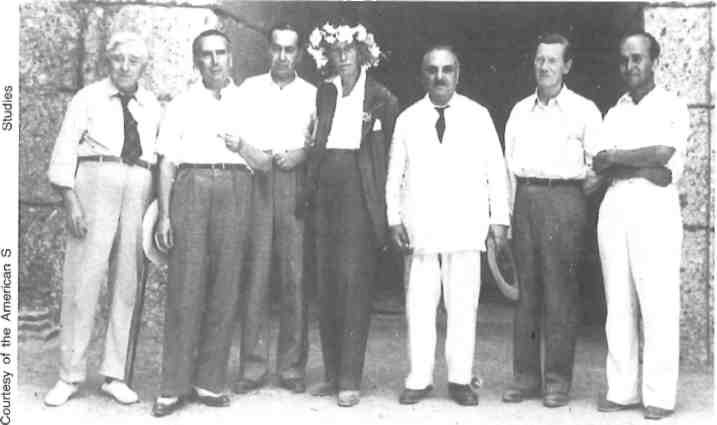
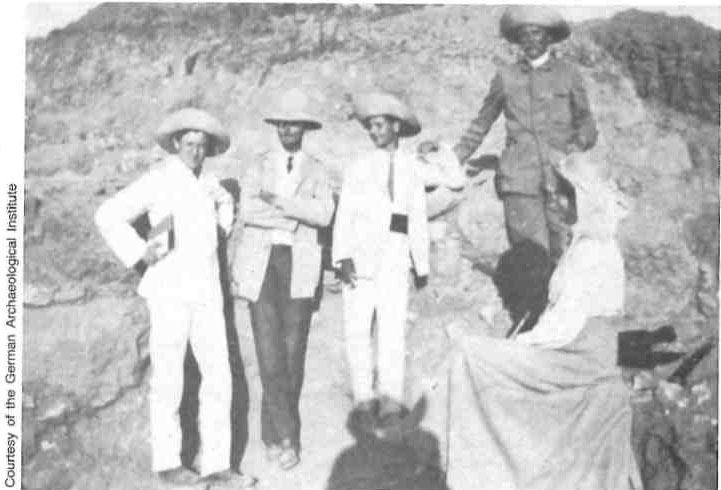
The French School was the only foreign archaeological institution in Athens for 28 years until the Germans opened their Institute in 1874, followed by the Americans in 1881 and the British in 1886. Although the Italians had what they called an ‘archaeological mission’ in Crete as early as 1898 when they began excavations at Gortyna, their official school in Athens was not opened until 1910.
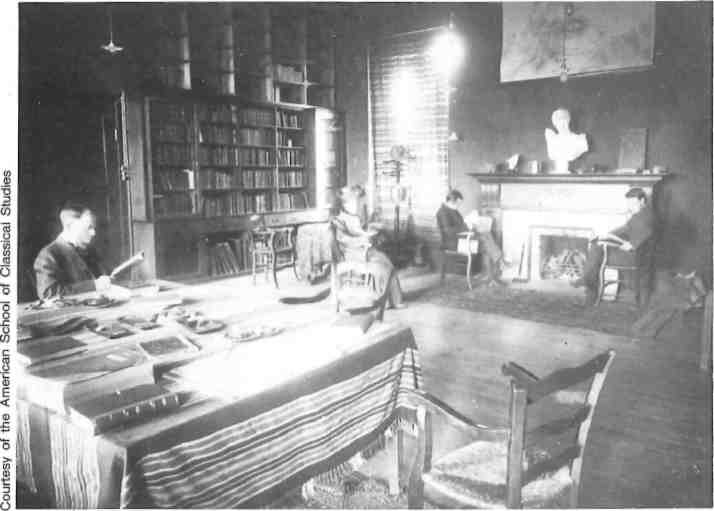
The American School of Classical Studies was established in 1881 largely due to the vision of Charles Eliot Norton, founder of the American Institute of Archaeology. He saw it as an outpost of American scholarship in Athens, a place where “young scholars might carry on the study of Greek thought and life to the best advantage, and where those who were proposing to become teachers of Greek might gain such an acquaintance with the land and such knowledge of its ancient monuments as should give a quality to their teaching unattainable without this experience.” The American School still operates according to these aims today.
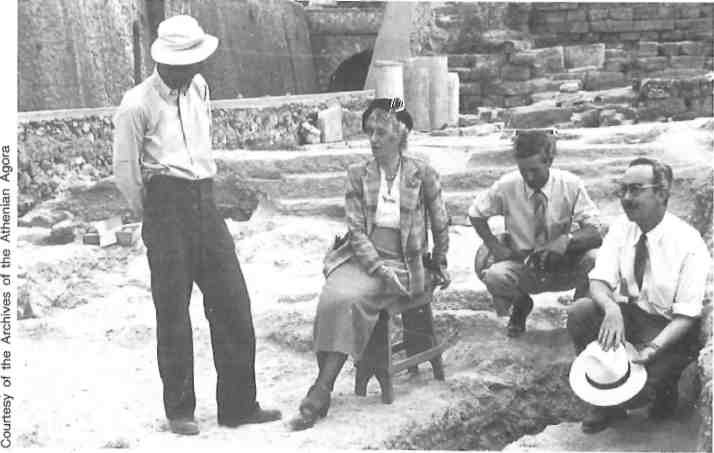
The American School moved to its present site, on the opposite side of Lycabettus from the French, in 1886, despite the fact that the location, now one of the busiest and more densely populated parts of the city, was then considered rather remote.
Unlike many of its fellow institutions, the American School is not a branch of the US government, nor does it have any official association with the American embassy in Greece. It depends on funding from the regular contributions of its many cooperating institutions (at present numbering 145) and on the income of a privately-created endowment. A managing committee, comprised of representatives from the cooperating institutions and a board of trustees, is responsible for the running of the School.
The British School of Archaeology was carved out of the same land holdings at the same time as the American School, and consequently the two coexist harmoniously side by side, sharing the same garden and a tennis court. The tennis court has been the cause of many an inter-school romance over the years; one member of the British School happily recalled that the presence of the American girls next door certainly “added to the gaiety of the place and the quality of the tennis.”
The British School is the most international of all the foreign institutions as it admits students from the Commonwealth, as well as from countries who do not have their own establishment in Athens. I remember one Christmas party in particular at the British School when we played games, and the teams were made up of two Koreans, an Italian, a Japanese, an Irishman, a German, a Turk, two Australians, and a few British.
The British School is supported largely by a grant from the government’s Treasury channelled through the British Academy. It also relies on private contributions to fund its excavations.
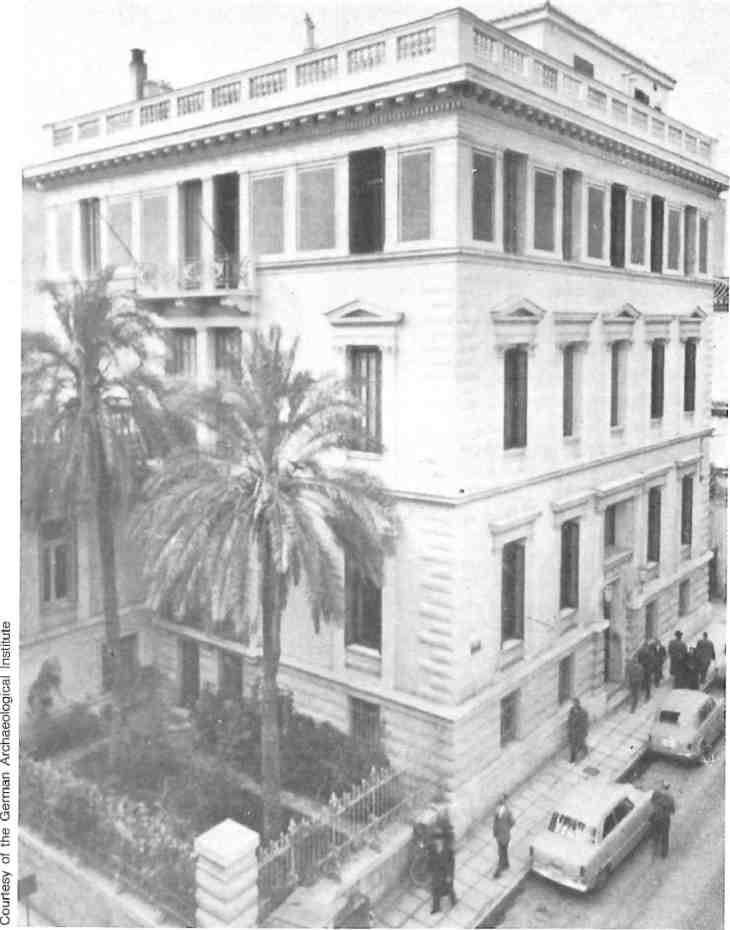
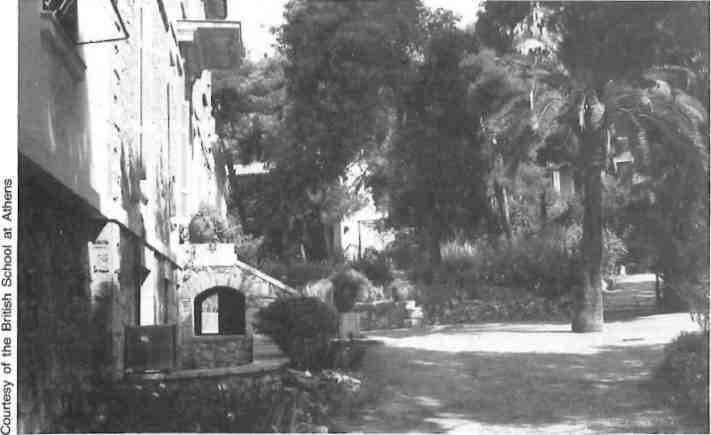
The older institutions are distinguished by their neoclassical buildings, spacious and well-tended flower gardens, and shady eucalyptus trees. The stately atmosphere inside speaks of a devotion to scholarly tradition and the rooms have the unmistakable smell of imported oak furniture and antique leather-bound tomes. The Swedes, Norwegians, and Finns have recently bought a number of neoclassical buildings in a single block in Makryianni near the Acropolis. They will soon be joined by the Danes, the plan being to restore the buildings to their original splendor and set up a huge library complex to be shared by the four institutions.
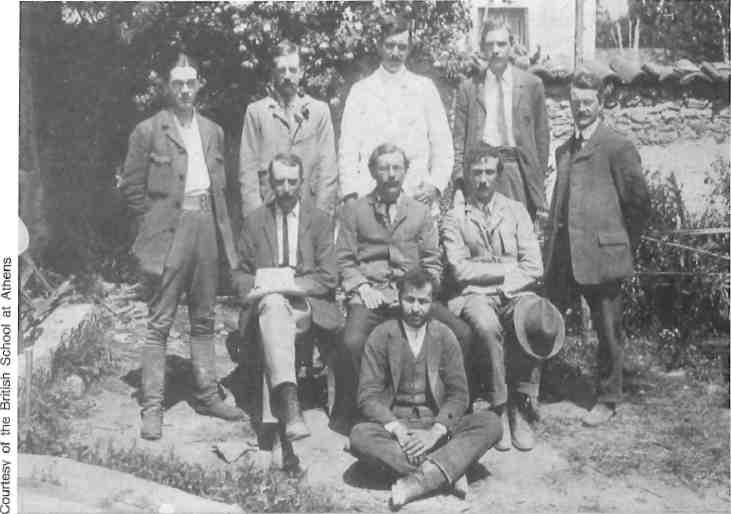
There is little difference between a ‘School’ and .an ‘Institute’; the differences between the foreign institutions stem largely from the cultures and philosophies of the different countries of origin. They are certainly more than urbane social centres for the academic elite. Some schools function entirely as research institutes for visiting scholars and students, while others offer programs of study. None has the ability to confer academic degrees. The American School of Classical Studies is the largest, and the only one at present, to offer a one-year non-degree program in Classical Studies and Archaeology, open to twenty graduate students. It includes four field trips during the fall to archaeological sites in different parts of Greece and has recently added optional trips to Asia Minor. Some, like the Americans and the British, also run special summer schools for undergraduates.
Each institution has a library, and the older established ones have come to specialize in different types of archaeological collections. The Americans have the Blegen Library with the best Classics collection, and the Gennadius Library whose 90,000 books are devoted to the subject of Greece from the early Christian era to modern times, as well as a rich collection of rare books, Edward Lear watercolors and the controversial Schliemann manuscripts. The British have the best general archaeological library and the French, the best collection of archaeological journals. Therefore, an archaeologist working in Athens has access to resources which cover all aspects of antiquity: ancient authors, histories, maps, excavation reports and specialized studies on pottery, sculpture, architecture and inscriptions. The archives of the respective schools also hold photographs, records of excavations and maps dating back to the earliest days of archaeology in Greece. Foreign scholars and Greek nationals are welcome to use such resources after obtaining permission from the institution.
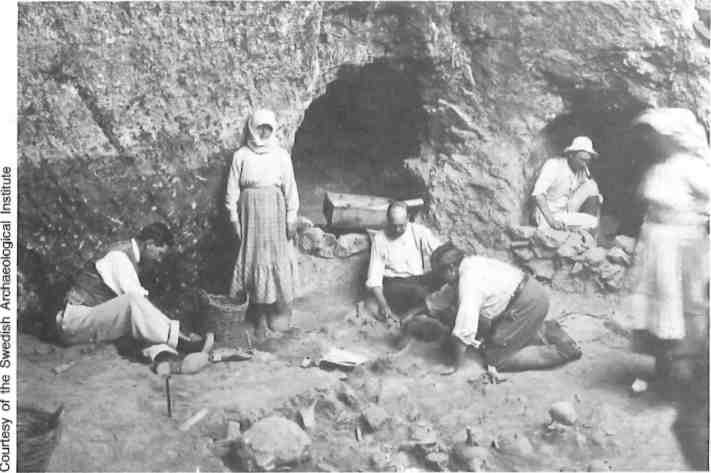
When it comes to excavation, the foreign institutions act as a liaison between the excavator and the Ministry of 3 Culture of the Greek government. An 5 archaeologist wishing to conduct research in Greece must obtain a permit through one of the foreign schools, which, in turn, submits the request to the Greek Archaeological Service, a branch of the Ministry of Culture. Each foreign institution is allowed to excavate at no more than three sites per year. However, there are five different types of permit available which does allow research, other than excavation, to take place:
1) Full-scale site excavation, or a ‘dig’.
2) Surface survey, in which digging does not take place but topographical surveying and examination of surface finds are permitted. Objects such as sherds can be picked up in the field, examined and taken to be stored in a museum for further study.
3) Synergasia (joint work) in which fieldwork is conducted in conjuction with archaeologists from the Greek Archaeological Service.
4) A simple study permit in which neither digging nor the gathering of surface finds takes place. In this case a particular region or monument may be studied but not physically altered in any way.
5) A ‘cleaning’ permit so that maintenance, cleaning, restoration and further study can be done of a site which has been previously excavated.
Work cannot legally take place without a permit of one kind or another. The Greek government also stipulates that a percentage of funds raised for excavation must go towards building and maintenance of sites and museums. For example, the museums at Nemea, Corinth, Isthmia and Stoa of Attalos in the Athenian Agora were built by funds from the American School of Classical Studies and other contributing institutions as a result of Americans digging those sites. Any antiquities discovered must remain in Greece and are usually housed in an apothiki (storeroom) close to the site of excavation. If the site produces enough impressive and significant material then a museum is built, usually by the foreign excavators who turn it over to the Greek state. Staffing and administration is the responsibility of the Greek Archaeological Service. Through their archaeological institution, individuals may apply to the Archaeological Service for exclusive rights to study and publish material. Some examples would be obtaining permits for scholars who specialize in the study of pottery, stone tools or human remains from a given site, or graduate students who need to examine specific material for dissertations. At no time are the antiquities allowed to leave the country.
Since the beginnings of archaeology in Greece last century, the most famous archaeological sites of Greece were handed over to foreign excavators to dig and so each of these sites has come to have a particular foreign flavor. Take a trip to Delphi in the spring and you will see busloads of French high-school students visiting the site. Although it is only one of many sites they will visit, it is clear that Delphi has special significance for them: it is a little part of Greece which has become French because of archaeology. Many of France’s most famous archaeologists made their reputation through their work at the site. A visit to the museum can make you think that you are in one of the galleries of the Louvre: all the labels are in French and Greek and the majority of visitors speak French. The local Greek shopkeepers usually address tourists in French before they try to communicate in any other language. Listen closely and you will hear a little French nationalism ringing through the words of the tour guides, whether they be French or Greek. The French are undoubtedly proud of the contribution they have made to the cultural heritage of Greece and the western world. Other famous sites dug by foreigners are: Corinth and the Athenian Agora (Americans); Olympia and the island of Samos,(Germans); Knossos and Sparta, (British); Gortyna on Crete, (Italians); Eretria, (Swiss), and the Australians have been excavating at Torone on Chalkidiki.
How do the Greeks feel about their archaeological sites being worked by foreigners? Ultimately, control is in Greek hands and foreigners cannot do anything without approval from the Greek government. The bureaucracy under which the foreigners must now operate was created as a reaction to violations committed last century when the Greeks themselves did not have control over their antiquities. The machinery is set up to stop foreigners controlling Greek archaeology or removing antiquities from the country. The relationship between Greeks and foreigners in archaeology today is healthy because it is essentially symbiotic, each gaining something positive from the other: foreign scholars need access to material and sites in order to conduct research; the Greeks need investment of foreign money in archaeology to help support and develop one of their most important resources, tourism. Perhaps the best example of cooperation is the synergasia, or joint work excavation where Greek and foreign excavators work side by side.
For more than a century the archaeological institutions in Athens have been concerned with the preservation of the monuments of ancient Greek culture, the discovery of new information and the dissemination of that knowledge to the widest possible audience. Although the dream of Cecil Harcourt Smith to have an international university in Athens, is unlikely to become a reality in the near future, the practical workings of the foreign archaeological institutions and the Greeks in the last decade of the 20th century is an example of another Greek ideal, armonia, harmony. With the cooperation of the Greeks and with each other they have created a unique example of international cooperation in an environment which operates above the boundaries of nationality and international politics.