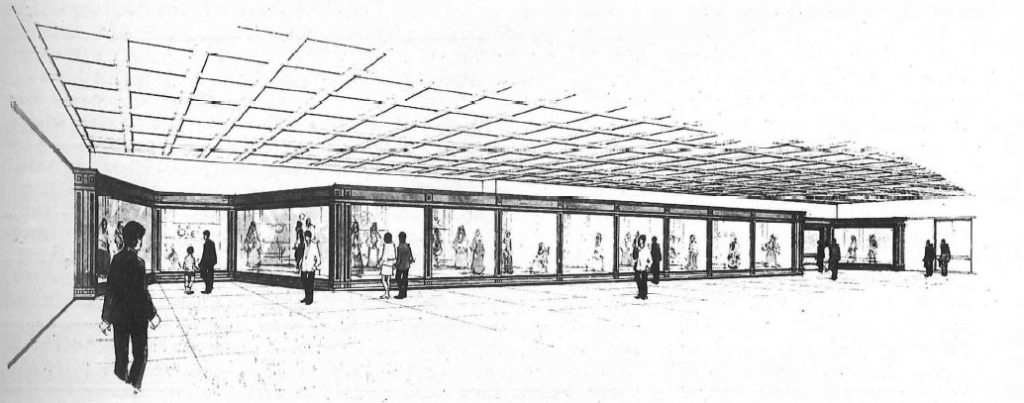
When the extension at the back of the Benaki Museum is finished, visitors will be able to follow the evolution of Greek civilization from Mycenaean and classical times, through Hellenistic and Byzantine to the period of Turkish rule and modern times, all under one roof.
Improbable though it may sound, this will be the first time a single museum in Athens has had exhibits permanently displaying the whole sweep of Hellenism, says the deputy director, Mrs Amalia Yeroulanou.

The project caught the imagination of the Minister of Culture and others campaigning for Athens to host the 1996 Olympic Games, so it was adopted as one of the civic, schemes given priority for completion in the next five years.
Building has already begun to provide office and curatorial quarters and storage. The existing neoclassical building designed by Anastasios Metaxas, the architect who restored the Panathenaic Stadium for the 1896 Olympics, is to be renovated with air conditioning, humidifiers, fire safety and security devices installed. Financial help is being solicited from a European Community fund for the restoration of historic buildings.
The distinguished Euformopoulos Collection of Chinese Ceramics, representing every dynastic period from Neolithic to the 19th-century is to be housed as an independent entity in a property next to the Kerameikos Cemetery donated by the great benefactor, Lambros Eftaxias. The important Antonis Benaki Islamic Collection, one of the museum’s main pivots, is also expected to have an edifice of its own.
With more space thus available, displays will be reorganized and arranged in the various rooms of the former Benaki family home, so those with limited time may on a single tour see how the rich and diverse aspects of Greek civilization developed throughout the ages.
Three additions have already been made to the museum since the death of the founder, Antonis Benaki, in 1954. A 1965 addition gave space for the archives of Eleftherios Venizelos, presented by his son, Sophocles, as well as display areas for the Damianos Kyriazis Bequest which includes paintings and prints of everyday life, landscapes and ancient monuments in the 18th and 19th centuries.
Three years later, in 1968, yet another addition provided for the Helen Stathatou Bequest of the complete carved wood wall-panelling, ceiling and fittings of an 18th-century Kozani mansion reception room. Finally, a wing was added with rooms for temporary exhibitions, lectures and refreshments in 1973, financed by the Stamatis Dekozis-Vouros Foundation. (He was the grandfather of Eftaxias.)
Expansion plans allowing for reclassification based on historical sequence are not new. Neighbors on the other side of the property line in Koumbari Street, running from Vasilissis Sofias Avenue to Kolonaki Square, knew about them when the Museum began building their six-storey block 15 years ago, says Mrs Yeroulanou: “They just hoped nothing would ever happen.”
The neighboring landowners ignored the requirement that there be no windows opening out on the side of a building lying flush with a property on a boundary. But in this case they even built balconies to take advantage of the view south looking over the top of the four-storey Benaki Museum into the National Gardens.
Now, of course, the museum’s extension threatens the illegal balconies, so the neighbors went to the Supreme Court, seeking an injunction to have the project banned. The court dismissed the application. The Benaki had its permit, and work on the foundations and the two lower storeys went on.
The neighbors’ lawyer then found a small flaw in the permit: it failed to give certain specifications about height. “It should have been phrased differently,” says Mrs Yeroulanou.
Last May the Ministry of Public Works ordered the building work to stop. Not until August was an official found with enough time to go and inspect the site. “He seemed clearly bent,” claims Mrs Yeroulanou, “on finding means to help the neighbors.”
In an effort to placate objection, the museum had architects begin a new study from scratch. Details were changed, such as the siting of staircases. This was finished by October and is in the hands of a ministerial architectural committee. Faced with such delaying tactics, museum officials can only wait and see what will happen, “but it doesn’t look as if the Ministry wants to help us,” says Mrs Yeroulanou.
The redrawing of architectural plans and the legal negotiations have cost the museum a lot of money, she emphasizes, explaining that the museum is funded partly by donations, partly by the state, with income from entrance fees and sale of goods. The small shop is located in rooms that were once her great-grandfather Emmanuel Benaki’s study, after he came from Alexandria in 1910 and went on to become mayor of Athens.
Delay in finishing construction has also meant another year gone by without being able to apply for the EC restoration grant. “We do our best. We have equipment to check humidity in rooms with icons and textiles. But in the new building such’things will be done more efficiently: it will be technologically perfect.” Still more, the upper storeys of the museum are now closed, used for storage and conservation work previously done in areas now affected by the new building.
“Everyone understands the importance of expansion,” says Mrs Yeroulanou. “It was an impossible state before: we had so many artefacts and not enough space to exhibit them and cramped areas for offices, working rooms and conservation. But now we are worse off than ever. It is a very sad story, though I’m sure it will end happily.”
An archaeologist who became a specialist in early Byzantine jewellery since her first job from 1964-67 at the Byzantine Museum, Mrs Yeroulanou counts among her major contributions to the Benaki the setting up of photographic archives since 1973. It is now run with backing from the Council of Europe and much used by scholars, researchers and students.
Bequests to the archives which she rates as especially useful are the photographs, many of Byzantine churches, of Pericles Papahatzidakis and the photo-reportage collection of Voula Papaioannou, both dating mainly from the German occupation; the collection of Rena Andreadi based on wide travels all over the country; and the work, including many portraits from early in the century, of the famous Greek photographer, Nelly’s.
The museum director, Anghelos Delivorrias, is also an archaeologist, specializing in ancient Greece, but knowledgeable on all periods. He tries to improve all collections, with particular interest in adding to ancient Greek sculpture, so he regrets losing the Erlenmeyer Collection of Cycladic statuettes most of which recently went into private hands.
Benaki blood still pulsates strong with the museum’s portico with its four fine Doric columns at the top of the broad marble steps.
The president of the Board of Trustees is the founder’s daughter, Mrs Irini Kaluga, Mrs Yeroulanou’s mother. Her own daughter, also Irini, is engaged in general management, and is qualified as a museum curator from study at Leicester University.
Also on the Board of Trustees is her husband, Marinos Yeroulanos who was with the Ministry of Economy in the Karamanlis era working on environmental affairs. Now he runs a fish farm for bass and bream on Kephallonia.
Mrs Yeroulanou is now taking up duties as an Athens city councillor, elected in the New Democracy-backed Tritsis team. While minister of Education in the Pasok government, the new mayor became interested in museum programs for school children which Mrs Yeroulanou launched in 1979 to mark the International Year of the Child, and is now imitated throughout Greece.
She also has wide experience of working with young people in the girl guide movement, being General Commissioner for Greece’s 16,000 girl guides for five years from 1983-88. That enterprise too was in keeping with Benaki family tradition: as well as setting up one of the most important museums in Greece, her grandfather Antonis Benaki was one of the founders of scouting in Greece, an activity many members of the family have been involved in.
Support for the museum is solidly witnessed by presentations of rare works of art, heirlooms, books and manuscripts, by generous donations helping fill gaps in collections and by the work of the Society of Friends of the Benaki Museum since 1957.
If an outstanding institution in Athenian cultural life for 60 years has to face such alleged obstruction in a legitimate undertaking, it is hard to be optimistic about the outlook for private enterprise the government claims to want to encourage.