These may be found today in Greece, Lebanon and Israel, and great numbers in Poland, Rumania, Yugoslavia and Finland. Orthodoxy never became a dominant form of Christianity in these latter places but it played an important role in the lives of the peasantry.
Icons of the post-Byzantine period are usually categorized into ‘schools’ of regional significance (the Cretan and Ionian, for example) or, in the case of Russian icons, according to specific patrons and areas of origin (Moscow or Stroganof schools). Convenient as these classifications are for art historians or those with a more refined sense of aesthetics, they hardly encompass all of the icons created during the 400 years following the Fall of Constantinople in 1453 and, once the expert has accomplished the rather arid task of establishing his criteria, there remain innumerable icons that do not fit anywhere. These are usually termed with some disparagement, ‘folk-icons’: that is to say, withlittle if any artistic merit, crude in technique, and naive in conception. If these are ‘accusations’ then they are certainly true.
Whether or not naivete and a lack of technical ‘know-how’ necessarily are a basis for absolute criticism is, however, questionable. Other measures may be used to place many of the icons of the post-Byzantine period in a category of their own so that they may be seen to be as artistically important as the works that emerged from the great ‘schools’.
Establishing criteria that encompass the great variety of folk icons is a problem. They are probably best grouped together on the basis of the fact that they belong to no definable ‘school’; that they reflect in general a lack of certain knowledge about the fineries of technique; and that the general approach to the subject is one of simple naivete. The point might also be made that they each show a uniqueness generally absent from icons belonging to the more readily identifiable schools. They are usually singularly lacking in self-conscious emulation as opposed to more sophisticated icons in which one is aware of the artist’s deliberate attempt to adhere almost slavishly to a long dead tradition or to introduce clashing western innovations. Atrocious as many folk-icons may be, from a purist’s point of view, they are usually fresh and, in many cases, display a spontaneous expression.
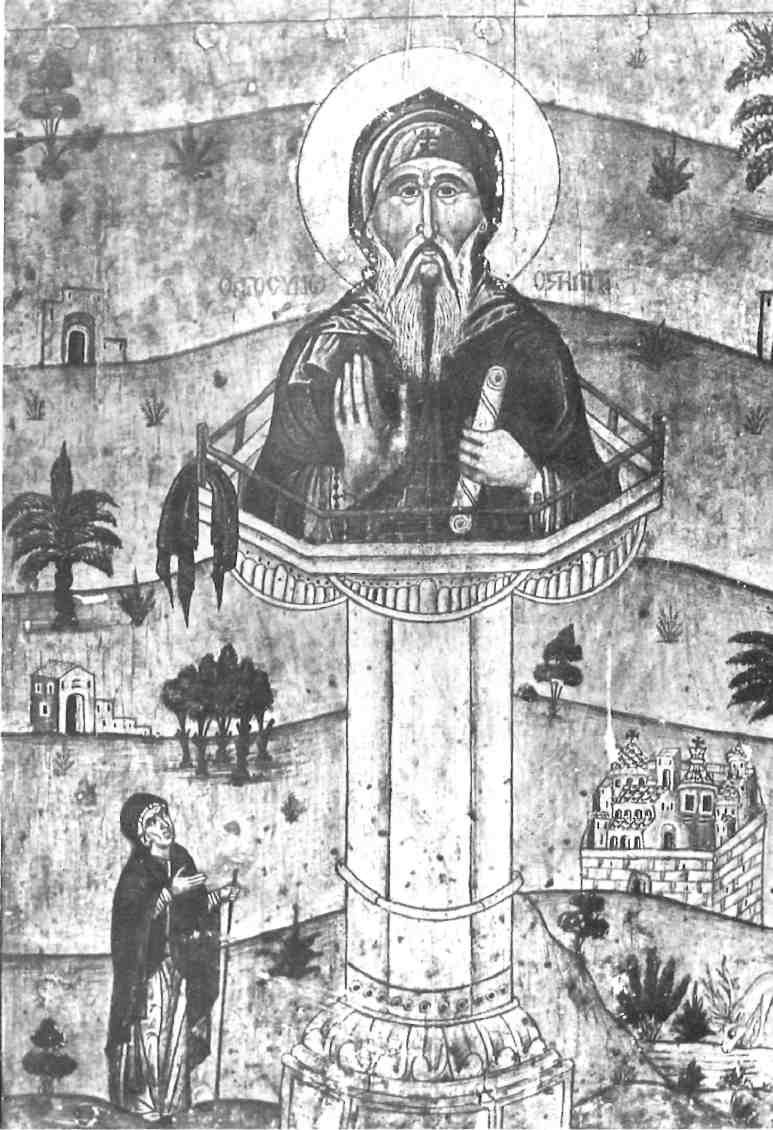
The icon of St. Simeon the Stylite, at present in the collection of the Lavra of St. Sabas in Israel, is a fine example of this. St. Simeon was a fourth century ascetic who sat on a column for some forty years. The popularity of his cult in the Early and Middle Byzantine periods can be judged from the numerous existing depictions of the saint and by the fact that his example was followed by other ascetics such as St. Alypios, St. David, St. Simeon the Wonder Worker — as well as an unknown ‘squatter’ who took up residence on one of the columns of the temple of Olympian Zeus in the 19th century. The Column Ascetics are all usually shown in similar poses: the body is shown only from the waist upward and the hands are raised in the position of an orans. The reason for showing only the bust was to avoid any similarity to pagan statues resting on columns.
The 18th century icon of St. Simeon reproduced on these pages is of special interest because of the distinct peculiarities that render it unique. It is possible to date this icon by comparing the base of the column with a similar (if not identical) one represented on a dated icon in the same lavra, the Vision of St. Peter of Alexandria. The latter was painted by a monk who signed his icons ‘By the hand of Ioasaph, Archpriest of the Arabs’. The date on the St. Peter icon is given as 1675 which would place the St. Simeon icon toward the end of the 17th or beginning of the 18th century.
One of the first clues to a break with the more traditional rendering of St. Simeon is in the fact that he rests on his column with one hand in salutation and the other holding a scroll and small rosary. He wears the habit of a fully initiated monk or what is known as the ‘megaloschema’. At the base of. the column stands a woman representing the saint’s mother who, eventually finding her son after many years of searching, was told by him that she could not enter the enclosure at the base of his retreat. On her death, however, she was allowed to be buried there. The mother of the saint is not found represented on any Byzantine icons and her appearance here seems to be the result of a fresh reading of the vita by the artist. It is also possible that the mother was drawn from icons of St. Alypios whose mother is sometimes shown at the base of his column — although here, again, only in post-Byzantine icons. Another unique feature is the presence of a small hart drinking from a brook. This may be an allusion to Psalm 42 (As a hart longs for flowing streams, so longs my soul for thee, Ο God…’) but it is more likely the result of an iconography based on the vita in which the story is told of a group of would-be pilgrims to the saint who, after slaughtering a hart, began to bray like donkeys. Simeon sent them to retrieve the skin of the unfortunate animal. It was stuffed and placed at the base of the column where it became a source of cures.
The background of this icon is especially interesting. The hills of the Judaean desert rise in undulating waves toward a very small patch of sky and in the midst of the hills hermitages, a small monastery, and the occasional tree are shown. There is much lacking in terms of artistic merit and finesse, but it is made up for by the spontaneous composition and the warm ochres, brick reds and viridian greens that were used, and the inclusion of genre elements that do not appear in traditional depictions. The fresh approach which the painter has used in developing his theme and composition gives this icon its special character.
The Deisis or intercession is frequently depicted on folk icons. This is a very ancient iconography in which Christ is shown as Pantokrator in the centre while the Virgin and John the Baptist appear on either side of Him interceding for mankind. Icons of this type are usually made up as triptychs in such a manner that the side wings fold over the central figure of Christ so as to form a cover. As portable shrines these were very popular in the Ottoman period and large numbers can be found that are easily assigned to various parts of Greece. Those from Macedonia and Thrace are usually quite large with very thin panels of wood used in their construction, whereas those from centr-al Greece are usually small with carved frames.
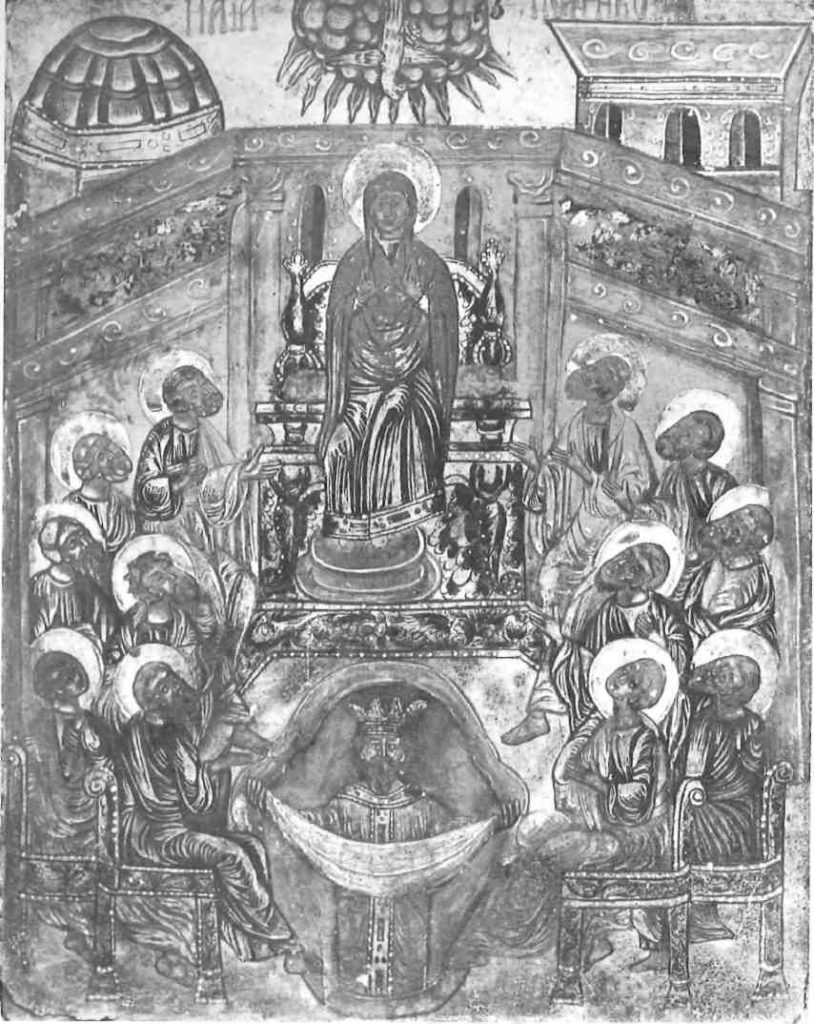
In some cases folk icons show a rather peculiar lack of regard for some of the niceties of theology that dominated the execution of Byzantine icons. The Pentecost scene is an interesting example of this. It once formed the second panel of a Diptych whose other wing has been lost. The ‘upper room’ in which the Apostles gathered is indicated by a brilliant scarlet wall behind which can be seen a dome and facade. The Virgin is shown seated on an ornate throne with her hands raised as an orans and around her are the Twelve Apostles who seem to be looking agitatedly upward both toward her and the Holy Spirit who emerges from a cloud out of which come twelve tongues of fire. The figure of the Dove resembles an Albatross, though its depiction has always been problematic to artists. Through a hole in the floor can be seen the emerging figure of Kosmos, or the world, meant to represent the various peoples, who spoke different languages, gathered together for the Feast of Weeks in Jerusalem at the time of the Descent. Kosmos holds in the outstretched cloth twelve scrolls representing the twelve messages delivered in the various tongues of the people who were present.
The presence of the Virgin Mary is of great interest. In early Christian art, at least up until the 6th century, she is usually shown at Pentecost as in the famous Rabbula Gospels, and was omitted entirely by the eastern Church at a later date. The reason for this change can be found in the manner in which the story is told in the first two chapters of the Acts of the Apostles. In Chapter I, the Virgin is mentioned as having been present at the election of Mathias to the Apostolic ranks. In Chapter II she is not mentioned with the Apostles when the Descent of the Holy Spirit took place. Early artists seem to have assumed that she was present on the second day as well. Later, however, she was omitted consistently since her inclusion seemed to question the unique validity of certain sacraments such as Baptism, Confirmation, and Holy Orders, as she had already received the Holy Spirit at the time of the
Annunciation. In the West artists seem to have been influenced more by Syrian and Palestinian prototypes introduced during the Carolingian period. The Byzantines consistently omitted her from the scene through the whole course of development. Her presence on this icon, which is of Greek manufacture but may have been made in Palestine in the 18th century, would appear to have been a sort of compromise: twelve, and not thirteen tongues of fire descend from heaven, yet the Virgin is shown as a focal point for the Apostles which reflects more the Western Church’s teaching that the Virgin is the ‘mediatrice of all Grace’ — a doctrine quite foreign to the Orthodox Church.
I have chosen these two examples of folk art icons in order to indicate the varieties of approach and interpretation that can be found in their execution. It is unfortunate that little if anything has been done to study more of them in any serious manner. Purists shy away from them and those who follow their lead simply paint over them in order to make good tourist items or, worse, simply destroy them. Only in the last few years has an interest developed in these peculiar and unique examples of religious art which reflect both the piety and the tenacity of the faith of the Orthodox Christians during the dark years of the Ottoman domination.