
But as soon as the new year is rung in, they sit down soberly to a game of chance: roulette, baccarat, poker, vingt-et-un, it makes no difference. They ‘take their luck for the year’ since, as people with a very long history, they know that almost everything depends on chance.
1991 is chancier than usual. It is the year of the tightrope. The government has to maintain a tricky balance between severe cutbacks in spending while preventing attempts at social agitation.
The seriousness of a debt is measured by the ability to pay it off and, at present, every man, woman and child in this country owes the equivalent to the pay of an average wage earner for a whole year.
For months the government has been shying away from asking for a loan from the International Monetary Fund. It has politely listened to, but publicly rejected, its recommendations so often that it appears to ‘protesteth too much’. It is felt, somehow, that resorting to an IMF loan is a kind of financial admission of failure, an ethnic tossing in of the jock, an ignominious retreat from ‘the good fight* – as if, in consequence, Greece might vanish from the face of the earth.
So, instead, the government says it will do much better borrowing within the framework of the EC. Better to be lost in the warm, but rich, embrace of Europe than disappear altogether.
The EC loan, however, has quite enough strings attached to make things wobbly for the. rope dancers who are trying to govern. Its demands for trimming public spending and consumer expenditure are difficult enough to satisfy in the face of a storm of strikes that greet each unpopular, but minimally required, piece of parliamentary legislation.
Nevertheless, the government went ahead with its plan to make a formal bid for the 2,200 million ECU loan. Unfortunately, like the earlier bid for the 1996 Olympic Games, the spirit of Dr Pangloss (or was it Pollyanna?) hovered too closely over the government’s hopes, and all of a sudden at the end of the year, there was a quick reshuffling of the playing cards. The application for the loan was said to be deferred for a few weeks – for purely ‘technical’ reasons, National Economy Minister Efthymios Christodoulou explained reassuringly, though a Paris paper was said to have run a headline ‘EC Rejects Greece’s Application for a Loan’.
With so many people on tenterhooks on whether the loan will come through or not, and still unclear about the conditions under which a loan might be granted, it might be well to look into the past for consolation.
One of the nice things about having a long and varied history is that one can always find what one’s looking for. One can even learn lessons from it, if so inclined. Therefore, if one likes taking a despairing view of life, Greek history is full of melancholy examples that will satisfy the gloomiest mood; if one is of an optimistic disposition, here are all sorts of glorious moments to support it. If one is eschatologically minded, it is full of suggestions for the world to end. It is a long succession of bangs and whimpers – one has only to choose.
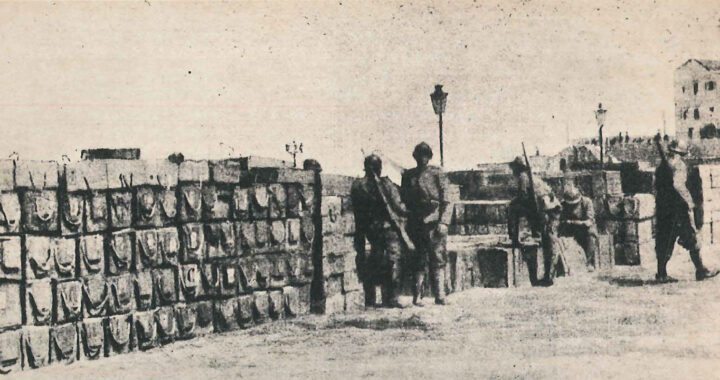
A recommended choice for this year, however, is a historical tidbit that is not even a century old: As a result of debts incurred for the brief but disastrous Greco-Turkish War of 1897, an International Economic Control established its offices in downtown Athens.
By the terms of the peace treaty, Greece was called upon to pay indemnities it could not honor and therefore, to establish proper guarantees, the country was forced to borrow from the Great Powers, chiefly Germany, but from five other countries as well. The IEC then more or less browbeat parliament into passing disagreeable measures that curtailed some of the country’s sovereignty. The financial agreements with the IEC’s shareholders were negotiated by the Director of the National Bank, Stefanos Streit, and Andreas Syngros, who was then the nation’s Mr Moneybags.
A committee was set up comprising six members, each representing a foreign power. Only in this way were guarantees underwritten for the servicing of old debts and the floating of new loans. This International Economic Committee began operating in April 1898, and the debt was paid off by absorbing the revenues from the state monopolies in salt, kerosene, lamp oil, matches, playing cards, cigarette paper and emery from the quarries of Naxos. It also was granted the taxes placed on the consumption of tobacco, revenue from postage stamps and duty paid at the Piraeus Customs Office.
Even Greek historians agree that the IEC did the country some good. It helped anchor the chronically fluctuating drachma, established a firmer foundation for international credit, increased the nation’s credibility abroad, helped stabilize the government, and caused a calmer atmosphere to prevail in the political arena.
The ironical thing about this whole situation is that it was caused by a war instigated by adherents of the Megaii Idea, the desire that all Greeks be free and independent of foreign powers.
Of course, history never exactly repeats itself or it would be tiresome and depressing. For instance, in 1898 there was no terrorist group around that could blow up the IEC offices in down-town Athens with impunity. For, then, the combined flotillas of the six Great Powers would have steamed into Piraeus and settled local matters as they saw fit. No such thing could happen today, so who can say there is no element of chance in history?
For 1991, Ladies and Gentlemen, please place your bets.