Then Rome changed and civilized the West, as much as this was possible. Irreparable time has gone by and, since the Encyclopedists, Classicism, a certain idea of Greece, prevailed through Western educational institutions. Indeed the study of Latin and especially Greek was the sign of profound erudition. This was quite understandable given the degree of retardation of the West during the Middle Ages and a certain lack of History still actual in most Western countries. The following expression of the Middle Ages says all about the state of ‘mind’ of the West of the time: Graeca sunt, non leguntur. Of course, the use of Latin gives it a certain style, but that’s about it.
Graeca capta ferum victorem cepit, et artes intulit agresti Latio. Horace
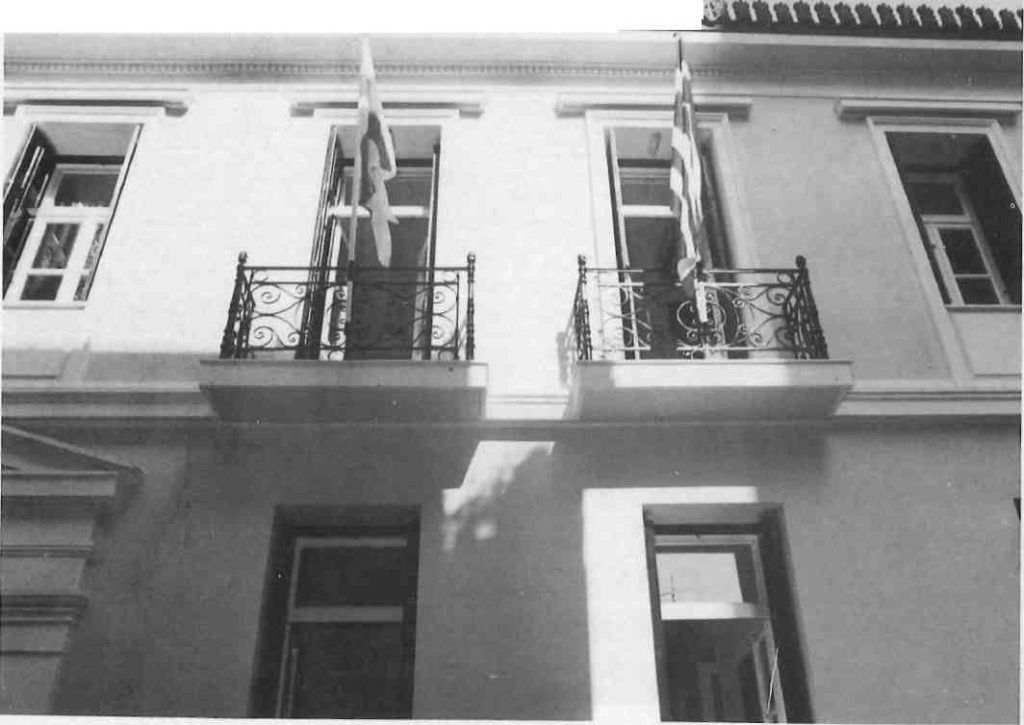
Byron spent his fortune and died for the freedom of the Greeks, the Modern ones. Many other Westeners did the same. Western governments fiddled about Greek politics in the 19th and the beginning of the 20th centuries. Some embassies established Archaeological Schools to combine politics and culture. This gave their blase archaeology employees, maybe teachers and students alike, a certain air of pomposity which some are still victims of. Most foreign Schools of Archaeology pledge hard core research, field work and, it is true, come up with impressive results. Combine this with an efficient foreign policy, and you will remark how they cut their coat according to their cloth.
You are in for a surprise when you consider the Archaeology Schools of the Scandinavian countries, most of which are recent. They subdue you with their Lutheran honesty and sense for hard work. One has the impression that the Scandinavians came to Greece to study and learn, not to drink themselves sick, for a change. Be this as it may, I felt immediately at home visiting and talking to the people in charge. Curiously enough, they are all lodged at practically the same triangular address: at Mitseon, Cavallotti and Zitrou streets at Makriyianni. Indeed, they have planned one project in common, namely the establishing of a common Nordic library for their teachers and students. That’s how four small institutes will soon establish a large and substantially rich library on our country and its long history.
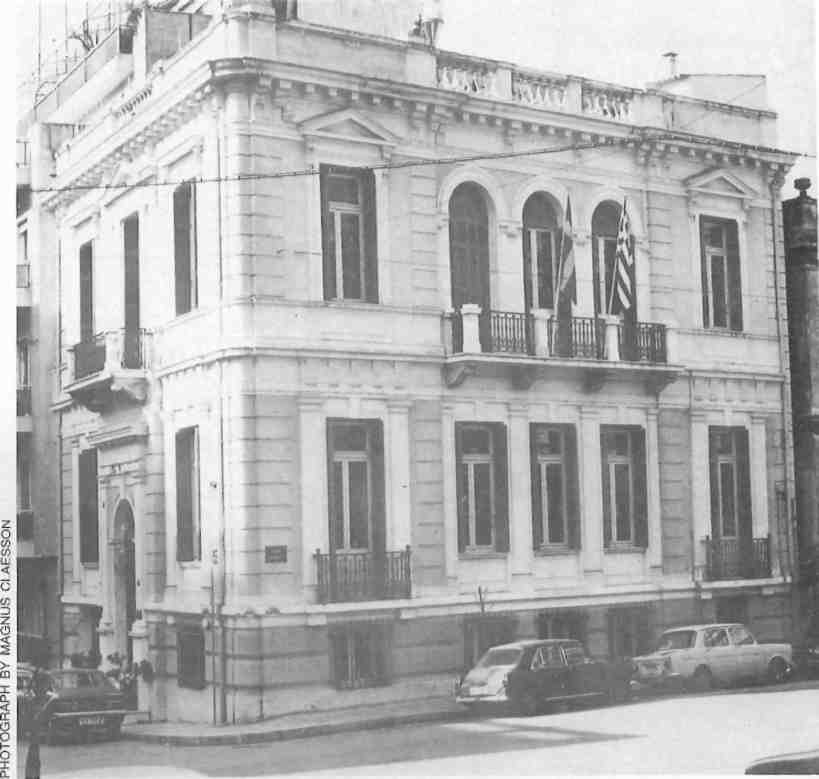
The Swedish Institute at Athens
Sweden tends to dominate Scandinavia in the international press, the first to establish an Archaeology Institute, as early as 1948. The Institute is financed by the Swedish state but also by the “Friends of the Swedish Institute at Athens”. Many companies, both Greek and Swedish, as well as private people have given grants to help the Institute at Athens grow and develop.
Despite the Classicist ideology gnawing Western universities, the Swedes have established a long tradition in exploring the Minoan and Mycenean era in Greece. The greatest representative of this trend is Professor Martin P. Nilsson and his work on Mycenean culture and Greek religion. This tradition is kept up through the daily activities of the Institute. Teachers and students come to Greece to attend courses, participate in excavations and take part in conferences. Courses include lectures, seminars, visits to museums and sites in Athens and Attica, as well as field trips to Crete, Thera, Delphi, Boeotia and Argolis.
Indeed, the Institute is busy receiving and organizing courses for students and teachers every year from January to March. Field archaeology excavation techniques are studied, and also a fresh up course in Ancient Greek culture is on the menu.
The Institute has long-running excavation projects at Asine, Nauplia, at Berbati Limnes, all in the Argolid, and on the acropolis of Midea at Chania on Crete. Papers and reports are published in the Institute’s periodical Opuscuhi Atlienicnsici. Needless to state that archaeological finds are exhibited at the museums or carefully recuperated by the Greek Ephorate in the respective regions.
The Institute organized its seventh international conference on ‘Agriculture in Ancient Greece’ in May 1990; interesting subject for ecologists as well. Many Swedish artists have been able to exhibit their work at the Institute; actually, musicians even played contemporary music from Sweden: a good combination of culture on the go between Greece and Sweden in a nutshell.
Sweden has four universities where one can study Greek language and history. The University of Uppsala is verily the only Scandinavian university where Byzantine studies are offered just to get acquainted with this part of Greece, which is not very Classic but all the more interesting as it helps to understand our modern culture in a comprehensive way. Greece is not only Pericles and Thucydides. Greece is also – especially for those interested in understanding modern Greeks – Anna Comnena and Michail Psellos. How else would you know that the word ‘encyclopedist’ comes from the encyclios paidia (secondary education) of the Byzantine Greeks?
Should you be interested in more, then:
Mitseon 9
117 32 Athens
tei: 01/923-2102
Finnish Institute at Athens
Finland is a lovely country of lakes and modern design where boat and ship building demands hats off on the part of any connoisseur. However, as professor Henrik Lilius says, “the country is in a very bad economic turn, and that is the reason why our Institute, which depends fully on subsidies from the Finnish state, is not expanding.” Believe it or not, the Finnish Institute at Athens is the poorest Nordic institute. “We have been spending money we never had and now the bill has hit us in the face!” dixit professor Lilius.
Finland is a country of mixed culture. Eight percent of the population, like professor Lilius, speak and naturally Finnish. Another eight percent is refreshingly Orthodox. The Monastery of Valamo is one of the most beautiful Orthodox monasteries one can and has to visit. It was moved from Eastern Karelia as 400,000 Finns had to leave their country when it was occupied by the Red Army, just like the Greeks had to leave Ionia, Thrace and Pontus to escape massacre.
The Finnish Institute was established in 1985 and despite economic difficulties has already organized two important conferences: a symposium on ‘Ancient Medicine’ in 1986, and another in 1987 on ‘Ancient Technology Students and teachers come from Finland to further their knowledge in Greek culture and many co-operate with excavation projects of other Nordic institutes as the Finns are not running any of their own. Writers and translators of Greek and Finnish are actually meeting in December in order to air out matters of translation between the two languages.
The Institute is lodged in an exquisite old house totally refurbished and surely has a brighter future despite the ephemeral financial difficulties. Professor Lilius is leaving Athens in December to go back to Helsinki to
take up the position of Ephor of Antiquities.
Zitrou 16
117 42 Athens
tel: 01/922-1931
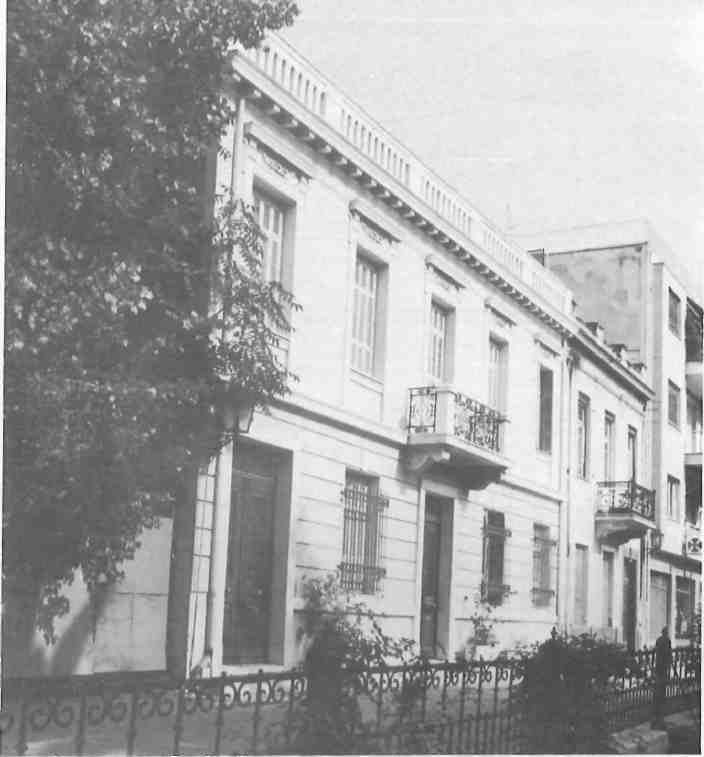
The Danish Institute at Athens
Denmark is the homeland of one of the greatest philosophers since Hegel, and an acute critic of the latter, Soeren Kierkegaard. It is the only European country of Scandinavia; one can notice that by how early Danes were involved in Greek things.
Peter Oluf Broendsted, the father of Danish Classical Philology, visited Greece in 1810. Indeed, the buildings of the National Library, the Academy and the University are designed by the architect brothers ‘ Christian and Theophilus Hansen. Further, the Hotel Grande Bretagne, the Zappeion, the Athens Observatory, to name a few more, are the work of Theophilus Hansen who also taught at the Athens Technical School until 1848 when Greek politicians came up with the idea to rule out foreigners from ”sensitive posts” in Greek public life. Later, and despite the ever changing political scene, when the Danish prince of German origin became King of the Hellenes, many more Danes came to Athens and Constantinople.
Hans Christian Andersen visited Athens and composed his travel experience where he wrote of the “greatness of the Parthenon, the temple of temples” and commented the missing Caryatid: “…where a broken column has taken the place of the Caryatid stolen by Elgin and held hostage in the grey British Museum.” Note that this was written about 150 years bM (before Melina). Ludwig Ross, a Dane of German descent, became in 1837 the first professor of Archaeology at the University of Athens.
Even if the Danes are old friends of this country, their Institute is not that old. Professor Soeren Dietz says that his institute specializes in the Archaic and Classical periods of Greece (800-150 BC). “The excavation and surveys at Lindos, Rhodes, and the southern parts of the island are where the interest of the institute lies. We are waiting for the permit from the Ephor of Archaeology in order to continue what had started in 1902 and went on for 12 years. So, the Southern Rhodes project remains the largest field project we have.”
Professor Soeren Dietz prefaced an excellent report of the excavations between 1902 and 1914 published by the National Museum of Denmark. What is interesting about the excavations and the field work is that it does not stop at the specified Post-Mycenean period but goes on to examine monuments of the Medieval period such as Byzantine pottery and graves as well as churches. If not in theory, then in practice, the Danes seem to link the long history of this country without stopping at the ‘period’ imperative dictated by some obscure scientific (Western) rationalism.
The University of Copenhagen has a Chair in Byzantine Music, a rarity in Western terms. This only stresses the quality of Greek Studies in Denmark where one can learn Greek under all its forms in no less than four universities. Denmark, it must be noted, has only five million inhabitants.
The Danish Institute is otherwise organizing a lexicographic seminar in order to publish a concise dictionary of Danish and Greek. In March 1993, Danish potters will visit Crete to learn techniques in Cretan pottery and, in July and October 1993, Cretans will return the visit. The Athens Polytechnic held a conference last December in honor of the Hansen brothers. The Danish Insitute is definitely of better quality than Danish cheeses, so give them a buzz. You won’t tear your hair in despair.
Cava!lotti 5
117 42 Athens
tel: 01/922-0789
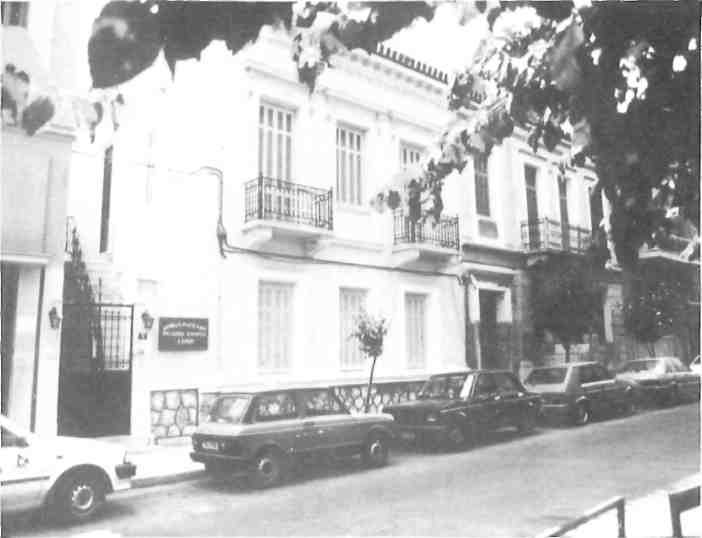
The Norwegian Institute at Athens
Norwegian wild salmon is definitely the best one can eat. Unfortunately, you can only get it in Norway because all else is fed hormones and antibiotics. Slalom, fjord, and ski are words Norwegian of an international touch. But the Norwegian Institute was established in 1989 and surprisingly enough it is the fastest growing and already one of the richest in the city.
Although the Norwegian state has the North Sea oil under its rule and is therefore one of the richest on this planet, it finances, as Ambassador Dietz of Norway said to me, “but a part of the activities of the Norwegian Institute.”
The emblem of the Institute are the four Caryatids symbolizing, as professor Andersen says, “the four Norwegian universities which support the Institute financially.” The Norwegians are lucky enough to have found in professor Ioannis Triantaphyllopoulos of the University of Athens their heaven-sent benefactor who has donated his tremendous library of 30,000 books and off-prints, one of the largest privately owned in Europe, to the Norwegian Institute of Athens.
As professor Triantaphyllopoulos is a teacher of Greek and Roman Law, his library contains mostly if not mainly books of philology, history and law. This makes it a paradisiac source of research for scholars of the genre. The Swedish Institute collects books on Archaic History, Archaeology and Greek Religion. As the Nordic institutes are planning on merging their libraries, it will give students and teachers alike extensive material to investigate in a single haul. The Norwegians have thus dreamt away a whole library and their Institute is as rich as Croesus in no less than three years. The Triantaphyllopoulos Library, as it is rightfully called, gives it a sense of grace unequalled by many, if not most, foreign schools at Athens.
Professor Andersen talked about the excavation project at the temple of Athena Alea at Tegea, Arcadia, where collaboration with other archaeological institutes has helped in uncovering the earlier history of the site before the classical temple was built. Money has a great say in how far one can go; the Norwegians are subsidized by American and Swedish funds as well as funds from their home country. That’s how it is.
The Institute has otherwise pubished books, one of which is entitled Hellas and Norway. It tries to reflect common traits in the history of both countries. The question is what do we have in common with the Norwegians? Besides love for the sea, mountainous landscape and numerous islands, nothing really. And luckily so. The seminars and courses which are run consider a foreigner’s approach to Greek culture and reflect much more their way of doing things than actual historic trends in Greece. This unfortunately is a vogue common to all foreign institutes. One understands much more their craze of Greece through reading their programs and projects and how they see things, rather than what Greek culture, past and modern, really was and is.
One should acknowledge that the Norwegians are trying to start in a divergent way by, as professor Andersen says, “combining research in archaeology with philology and history in the many phases of Greek culture: from the archaic period to Byzantium and modern Greece.” A novelty as far as I know. The Norwegian Institute is also an extension of universities in their country where Greek studies are not widespread, as in Sweden or Denmark. Only ancient Greek is taught, while if one wants to study Byzantine and modern Greek, then one has to travel to Sweden or Denmark, or simply to Europe. Professor Andersen’s plan for 1993, who, by the way, is a philologist, is to do something about that; namely, to create a course in Byzantine studies, contributing thereby in expanding this field of Greek studies in his home country, too.
I was surprised to find out that the Norwegian Institute is also planning a pubication on the ‘Nationality Question in Macedonia’, a thorny subject by any standards especially for a new foreign school which, if one should judge from the book Hellas and Norway, has but shallow understanding of Greek politics. The better part of valor is discretion.
In any case, the Norwegian Institute is definitely worth a visit as people there seem to be more aware of linking the many phases of Greek history rather than specializing in Parnassian Classicism and whatever rarities come with it. This gives the Institute a bright future and makes it stand out among the foreign archaeology schools in our country. Surely enough this was one of the reasons why professor Triantaphyllopoulos donated them his life’s work.
Tsami Karatasou 5
117 42 Athens
tel: 01/923-1351