Suddenly the dear old slogans, catch-phrases and metaphors seemd to have lost their savor and momentum. Gone was the PASOK Express – that celestial choo-choo speeding its passengers to Nirvana – dried up that irreversibly flowing river bearing the common man down to the socialist sea; lost the confidence that the government would sweep on uninterrupted into the 21st century. Even the presidential thrones seemed to have gone – gone out of circulation and in for repairs.
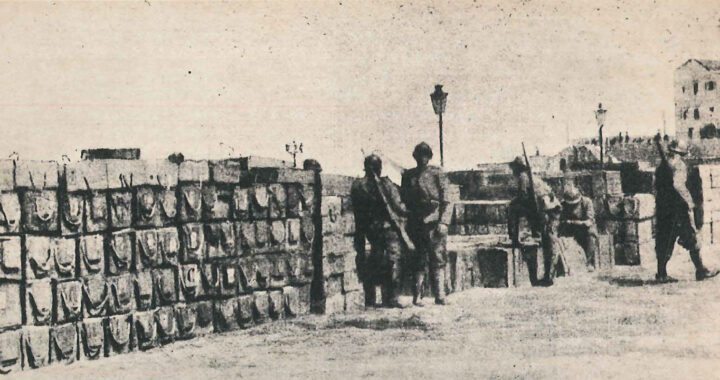
The New Humility, as a government policy, was best expressed by the prime minister himself when he said last month, “I am no more than the servant of the people.” He expressed pleasure and thanks, too, that leaders of all parties were present to celebrate the 44th anniversary of the blowing up of the Gorgopotamos Bridge during the occupation, and welcomed the fact that the resistance was no longer a partisan issue to be pounced on for political advantage, but one accepted as involving all Greeks. “We are gathered here today to honor the national resistance fighters, to put an end forever to division and to declare a new course on the road to national reconciliation,” he said. Echoes of Lincoln seemed to be heard in the hills of Fthiotis.
Later, Mr Papandreou even turned a paternal, sympathetic ear to proposals that “free” radio stations be established to help break the monopoly that governments have always had over the airwaves and which is written into the constitution. In fact, the idea was first expressed publicly by his son, George, undersecretary of culture. “Every citizen,” the prime minister said, “has the right to set up a local station,” though if this right were implemented it might make even the most freedom-loving citizen balk. The form of state control regulating these stations, however, has been left vague. And to the question “If free radio comes, can free TV be far behind?”, the answer seems to be a firm “No”.
The general odor of sanctity, however, was somewhat dissipated by the pungent scent of a growing number of public scandals and a two-week strike by garbage collectors on the eve of Christmas. The alleged misuse of public funds, particularly in regards to the telephone and electric companies just as the announcement that the rates on these utilities were rising 25 percent, reinforced the impression that the beleaguered private sector was paying handsomely for a wide assortment of public pilfering.
This involved not only utilities but state-controlled banks and industrial firms, the resale of Yugoslav wheat through the EEC, contracts on the construction of thermoelectrical stations and warships, as well as funelling naval resources to stock a boutique. The last case is interesting mainly in pointing up a striking and recent economic phenomenon. While wages of workers are frozen, readjusted wage-inflation scales miniscule and austerity measures bruited about and reinforced, luxurious boutiques are as flourishing as video clubs. It suggests that a lot of loose money is floating around that must have come from somewhere – perhaps inexplicably, like manna, from socialist heaven.
This speed of social mobility – up and down – is what makes Greece such a lively place, and never is it so noticeable as during the holiday season, when whole stocks of furs, jewels and Paris collections are swept up and fortunes are made and lost at tables of roulette and chemin de fer.
The proliferation of strikes have lately become equally characteristic of the season. Last month’s-to give a smattering of examples – involved ERT 1 and 2, school teachers, longshoremen, hospital attendants, postmen, dairy producers, reformatory school staffs, the metro and, above all, the garbage collectors.
These latter workers want higher wages and “tenure”, but the government is reluctant to give in to these demands, holding to the self-contradictory belief that if the benefits are too great, the workers will not hold on to their jobs. Perhaps this is seen as just another example of upward social mobility, but from the looks (and smell) of Athens last month, it seems obvious that the garbage collectors are the most essential members of the public sector and should be treated as such. It is the armies of clerks and petty bureaucratic officials which are expendable.
If at year’s end “better days” had only come for dogs, vermin and the city’s huge population of cats, Athenians were looking forward to 1987 with their inveterate and unbridled optimism. The cost rise in electricity can only mean more restful sleep and less silly TV; in telephone charges, less gossip; in water, less washing; in transportation, more jogging; and in cigarettes – for the heaviest smokers in the EEC – better health.